





Medieval beauty secrets for your constitution.
It takes 4 minutes to find yours.


Medieval body care. Timeless formulas.
Every formula starts in a medieval monastery garden: the Benedictine physic gardens and infirmaries, and Hildegard von Bingen's record of what each plant could do. Eight hundred years on, we still use them.
Medieval body care. Timeless formulas.
Every formula starts in a medieval monastery garden: the Benedictine physic gardens and infirmaries, and Hildegard von Bingen's record of what each plant could do. Eight hundred years on, we still use them.
The Essentials
Our four foundational formulas.
The herbs of gardens, and the herbs watered by the rivers that flow from the East, are full of virtue — they carry a good scent, and are good for medicine.
St. Hildegard of Bingen, Causae et CuraeFrankincense and myrrh — the gifts the Magi carried to Bethlehem — were ground into wound salves for centuries. The oldest medical book of the Latin West, written at Lorsch abbey around 795, gives the recipe.
Sea moss (Chondrus crispus) is up to half carrageenan — a sulfated polysaccharide that holds water at the surface of the hair and dries into a flexible film.
The plan of St. Gall, drawn around AD 820, lays out a physic garden of sixteen beds — the oldest surviving garden plan in Europe.
In the first century, Dioscorides — a Greek surgeon marching with Nero's army — compiled De Materia Medica, the herbal that stood behind nearly everything Europe would write about plants for the next fifteen hundred years.
The most High hath created medicines out of the earth, and a wise man will not abhor them.
Ecclesiasticus 38:4Medieval herbals prescribed calendula for wounds and broken skin — and medieval poets set the golden flower among the flowers of the Virgin, which is how it came to be called Mary's gold.
Tallow is built from oleic, palmitic and stearic acid — the same long-chain fats that structure the skin's own barrier, which is why it melts at body temperature and sinks in rather than sitting on top.
In the 840s, Walafrid Strabo, abbot of Reichenau, wrote Hortulus — a poem walking his abbey garden bed by bed, twenty-three plants, the first gardening book the Middle Ages produced.
Violet leaf smells nothing like the flower — cold, green, cucumber-sharp. That's (2E,6Z)-nona-2,6-dienal: barely one percent of the extract, and almost the only thing you smell.
Before all things and above all things, care must be taken of the sick — that they be served as Christ himself is served.
Rule of St. Benedict, Ch. 36At Salerno, medieval Europe's first medical school, a woman named Trota taught and wrote the book on women's medicine — it traveled Europe for the next four hundred years.
Cedarwood's grounding scent comes from cedrol — a sesquiterpene alcohol that can make up a quarter of the oil. Warm, dry, resinous.
In the 1100s, St. Hildegard of Bingen catalogued the healing virtues of 230 plants, 72 birds, 37 fish, and 26 stones in her Physica.
Rosemary is ros marinus — “dew of the sea” — for the way it grows wild along the Mediterranean coast.
…and of these the apothecary shall make sweet confections, and shall make up ointments of health, and of his works there shall be no end.
Ecclesiasticus 38:7Medieval laundresses dried their linen over lavender bushes — which is how the plant came to be tied to lavare, to wash, and why the name still smells of clean cloth.
Peppermint's menthol activates TRPM8, the skin's cold receptor — so it feels cooling with no real drop in temperature.
Around the year 800, Charlemagne ordered every royal estate to grow the same list of plants — seventy-three herbs and vegetables, sixteen fruit trees, lily and rose and sage and rosemary and rue among them.
It started with a question about herbal medicine and what it could still do today.
Four products that work together: replenish, anoint, repair, defend.
Our values, and why monastic herbal tradition matters for modern body care.
Understand your constitution and its unique needs.
Learn what a 12th-century abbess would make of you: your skin, your constitution, and the botanical remedies that suit it.
Love notes
“This salve is so soothing and healing. Smells like a dream. I love the Humble Housewives' products.”
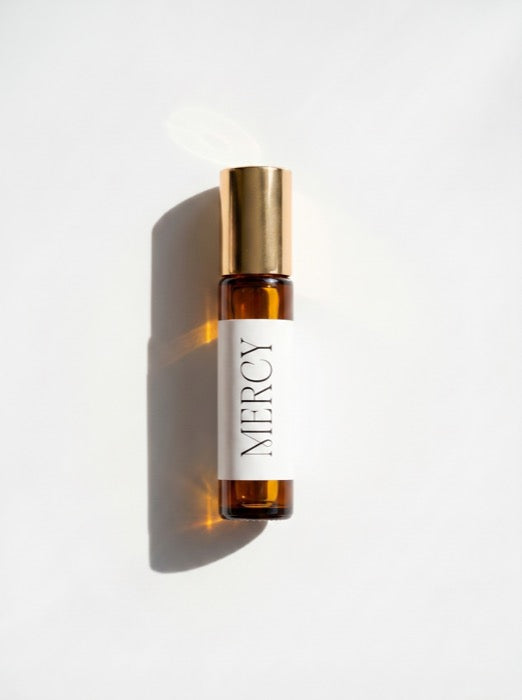
“I've ordered the Mercy Defense Oil for two years now. I love the smell and wear it whenever I leave the house.”
“It worked on my hair — I have some curls and it's perfect. No frizz, I have body, and the smell! None like it.”
“Absolutely adore this roll-on! One bottle lasts quite a while, making it such a worthwhile purchase.”
“I love this oil and use it daily on my face. It helps with the dryness from the weather.”
“This salve is so soothing and healing. Smells like a dream. I love the Humble Housewives' products.”
“I've ordered the Mercy Defense Oil for two years now. I love the smell and wear it whenever I leave the house.”
“It worked on my hair — I have some curls and it's perfect. No frizz, I have body, and the smell! None like it.”
“Absolutely adore this roll-on! One bottle lasts quite a while, making it such a worthwhile purchase.”
“I love this oil and use it daily on my face. It helps with the dryness from the weather.”